Thursday, May 2, 2019

How Amazon Uses The Echo To Influence Elections

Amazon Echo streaming device.

Florida Campaign ads appear on Oregon radio station?

Several nights in the fall of 2018 with the midterm elections looming I was using my Amazon Echo to listen to Ground Zero, hosted by Clyde Lewis.  His show is broadcast on KXL 101 FM based in Portland, Oregon.  I live in Florida.

Imagine my surprise when during one of the commercial breaks I heard ads for Democrat candidates here in Florida!  Those included Andrew Gillum, Senator Bill Nelson, Congresswoman Stephanie Murphy and Florida Senate candidate Kayser Enneking.  Of the four, only Stephanie Murphy would go on to win.

I never heard any ads for Republican candidates or Independents, only Democrats.  This follows in line with their bias against the Republican party.  In the election of 2016, Amazon featured jokes on the presidential candidates that a user could ask their AI, Alexa. Those jokes were only for Republican candidates—never any Democrats.  No Hillary or Bernie jokes.  I know, I tried.  Did they ever consider that more than Democrats own the Echo?  Apparently not.

Technically, I have no answer for how they did this.  I don't believe the Florida ads were being broadcast on KXL.  I assume Amazon had a way of inserting the ads into the ad rotation, externally.  I also tried another station that Ground Zero airs on, WGST (Atlanta), but did not hear any Florida campaign ads on that station.  I conclude they know what station I listen to on a regular basis on my Echo and targeted it.  They database all users of the Echo device and catalog lots of user data such as their phone numbers, address, most listened to radio stations, artists and so on.

I was only able to make recordings of only two candidates, Kayser Enneking and Stephanie Murphy.  

So finally, Amazon's attempt to influence the election cycle was a failure.  It will be interesting to see what they attempt in 2020.

You may go to Soundcloud link below to listen to them at Soundcloud:


https://soundcloud.com/geoguitar-1/sets/alexa-recordings


Wednesday, March 13, 2019

The Mystery of Apollo 13


Will We Ever Know the True Story On Apollo 13?

Jim Lovell’s book reads like an account of the movie Apollo 13 rather than a story of the actual event he participated in.   Some of the science in the book is flawed and some of it ranks as absurd.  In other areas the documenting of dialogue exchanges between the Apollo 13 astronauts and Mission Control are provably false.  I am at a loss to explain why this was done since Lovell and co-writer Jeffrey Kluger are supposed to be telling us the truth.  There are enough voices crying “fake” regarding the moon landings as-is and this book’s flaws just adds more reasons for their theories.

Center of gravity in no gravity…
Shortly after the fuel cells blew the Command Service Module (CSM) and Lunar Landing Module (LM) were thrown out of wrack.  The attitude control was thrown off and Jim Lovell’s job was to get the trajectory to conform to the flight path, which he accomplished after some difficulty.  

On page 148 in Lovell’s book it is stated that the added “weight” of the command module, coming in at 63,400 pounds, was causing the problem. It was actually stated that the attached CSM's weight which was throwing off “the center of gravity” of the ships.  Is there a center of gravity in no gravity?  Of course not!  Everything weighs nothing.  And how did the CSM suddenly gain weight in zero G?  Please note this is not an issue on a normal mission when the CSM is in control and LM is docked and not being used to transit to the moon.  

All of this is patently absurd.  Co-author Jeffrey Kluger, an otherwise good science writer obsoletely failed the readers with this nonsense.  It should also be noted in NASA’s Apollo 13 Mission Report, that none of this was ever mentioned regarding weight throwing off the guidance system.  I am surprised Jim Lovell let this go through, or anything such as this, is written in a serious book on this near fatal disaster.  After all, this book is a reprint of Lost Moon, originally published in the 1994, and this flaw, with a host of others, is in that book as well.  There clearly was enough time to correct this.

And to go even further, it is stated on page 225 that the added weight of the CSM was checked out in the flight simulator by two astronauts to see if it would effect the guidance system.  No problems found.  Of course not!  The very idea that they would be doing a test in a simulator when they have to know the CSM weighs nothing in zero gravity, is astonishing.  


(Also, the LM’s weight is never noted.  It was still weightless?  Of course it was as the CSM had to be.)

(None of this reported CSM weight issue is mentioned in NASA technical reports such as the Apollo 13 Guidance, Navigation, and Control Challenges report,  Apollo 13 Mission Report, and the Apollo 13 Flight Journal transcripts.  Links below.)

Pulling the bio-med sensors
Jim Lovell’s irritation with his biomed sensors and the removal of them made for a fine dramatic effect in the Apollo 13 movie, when actor Tom Hanks in the role of Lovell, ripped his off.  

However, it made for the worst part the book because the incident is falsely presented with an invented conversation between Lovell and mission control that never happened.  As the book describes, after Lovell removed the biomeds he was concerned that he would get a lecture by flight controller Vance Brand who supposedly knew he had done this.  He was not reprimanded but was told to turn off his biomedical transmission switch.  The fact is, this conversation is not recorded in Apollo Flight Journal transcript.  According to the transcript, Lovell was told by flight controller Joseph Kerwin to turn off the biomed switch in the LM to conserve power.   Nothing more.  Also, The Apollo 13 Flight Journal, states that once the CM was powered down, all biomed data from the astronauts was no longer being transmitted to NASA.  Brand, if he had actually talked to Lovell would have known this and would not have been able to detect that Lovell’s sensors had been removed.  Besides, at that point, the astronauts were not plugged in to any ports to upload the data.  However, they might have had wireless data transmission since the sensors were connect to the biomes belt the astronauts wore.  But this is unclear in any NASA documentation available. It is clear that to communicate with ground control, they had to be plugged in via a comm cable.

So, the incident as reported by Lovell and Kruger is false, according to NASA’s official transcript.  It is unknown why they would bear a false witness regarding this incident.  

Even the official report features odd flaws
Just as Lowell’s book features constant references to measurements based on pounds, so does the Apollo 13 Mission Report.  For example, it is stated on page 5-11, that 55 pounds of propellent was used for third stage buster separation. On page 5-13, before the command module was shut down, 14 pounds of water were transferred from the CM to the LM.  Overall, some thirteen pages of the report reference pounds as a measuring system.

I am surprised that in an official report such as this, the use of “pounds” being used as a unit of measurement while in zero gravity.  In zero G, how would they know the exact weight say, of water in a tank?  How did they measure 14 pounds of water in zero G?  There is no gravity, hence no weight.  In my research, I have yet to find an answer for this. I don’t see this questioned anywhere.  I also don’t know why the moon Hoaxer crowd hasn’t jumped on this as evidence of fakery.  After all, the only place pounds could be measured would be on a sound stage in Earth.

Even one of the electronic schematics is wrong, showing an output component with no input listed.  There would be no output without an input.

Question
Why are none of of the reviewers of this book on Amazon catching any of this?  

Will we ever know what happened?
Overall, Apollo 13 reads like a dumbed down account of what happened aboard this doomed ship.  Too much dramatic license is taken to the point of making things up.  It’s an insult to the brave men who nearly lost their lives, and to the superb group of technicians and engineers that helped bring them home safely.

The public which paid for the space program deserves the truth.  


Sources

Apollo 13, Jim Lovell, Jeffrey Kluger
https://www.amazon.com/Apollo-13-Jim-Lovell/dp/0618619585/ref=sr_1_2?keywords=Jim+lovell&qid=1552480406&s=gateway&sr=8-2

Apollo 13 transcript, Biomeds

The Apollo 13 Flight Journal

Apollo 13 Mission Report

Apollo 13 Guidance, Navigation, and Control Challenges, John L. Goodman
https://ntrs.nasa.gov/archive/nasa/casi.ntrs.nasa.gov/20090026451.pdf

Thursday, January 24, 2019

Are The NASA/JPL InSight Images Faked?

Mars ICC camera image on the left.  IDC camera image on the right.
Curious discrepancies in Mars NASA and JPL imagery.

I first started working with 3D computer generated illustrations on the Commodore Amiga in 1986.   The first good rendering program was Sculpt 3D.  The basic principle is to take a 3D object file, basically a geometric object made of polygons, attach textures, set up lighting and environmental features and select Render.  Due to the technology at the time, I had to run my Amiga all night to get a simple rendering of basic objects.  It was a fun and experimental method of artistic exploration that only the people at major studios could do at the time, making it’s way to the masses at home.  It was art not made by hand—instead the computer did the drawing and painting.  

Fast forward to 2019 and the CGI has gotten to the point of hyper-realism as seen in such films such as The Lord of Rings, Avatar, and a host of sci-fi films and TV shows.  Having a background in photography and CGI I think I am well versed in spotting what is real and what is not.  And much coming out of NASA and the Jet Propulsion Lab (JPL) of late is obviously, fake.  Have you seen the NASA image of North America much larger than its actual size?  Or of North America totally in green with no desert areas or snow capped mountains?  It is out there.  I fail to understand why, with the sophistication of cameras and software to transmit pictures back to earth, why they would resort to this fakery and fakery not well done either.

First image on InSight lander.

A Case In Point
A case in point is the new images arriving from the InSight lander on Mars.  The first image broadcast to the world came from the lander’s Instrument Context Camera (ICC).  It was a muddy image, barely in focus with large spots on it described as dust.  The color and lighting are awful.  The horizon is distorted into a hoop by a fisheye lens.  The is a hideous looking image, taken with an expensive digital imaging device that does not look as good as images made over a 100 years ago on Civil War battlefields.  This did not prevent the crew at NASA from standing up and cheering just like their team had scored a touchdown in a game they have yet to win. Regardless, it looks like the only real image that is being transmitted back to earth from the InSight lander. (Notice that the ICC camera image features a blue sky.)

Of note: even the most recent images from the ICC still have the dust specs on the lens.  They don’t have a method of cleaning them off?

InSight IDC image.  Camera or CGI?

Instrument Deployment Camera (IDC) to The Rescue
The IDC images are a radical improvement over the ICC images.  The resolution, color and contrast look fantastic!  No crazy distortion of the horizon and even more importantly, no dust spots on the lens.  

Looking at them for a while I noticed something is not quite right.  Quite simply, these IDC images do not have the look of photographs.  They are too sharp.  A real camera with the best sensor will never reproduce an image as sharp as the eye will.  There is only so much resolving power between optics and a CDD sensor.  

Another issue is the Depth of Field (DOF).  All images are super sharp from foreground to background.  When shooting wide open spaces, such as landscapes, this is not hard to do and only requires the proper aperture setting.  In close up, or macro photography, aperture is set for the focal point of the image, but there will be some blur in background details.  The IDC images are mostly of close ups of the various instruments and components of the lander. Yet the Martian background is not blurred.  

The zone of sharpness is all over the place in these images.  No blur anywhere.  In actual photography, there is always a trade-off between brightness and shadow; between focus and blur.  These pictures feature no trade-offs at all.

Why does the IDC camera always stay clean of dust?  No spotty images ever.  The poorer quality ICC camera stays filthy.  And while on this matter, why is the overall hardware of the InSight lander so pristine?  Mars is noted for having a dusty environment with its planet-wide dust storms.  Not a spec of dust is to be seen on anything.  

These pictures are billed as “raw” images.  If so, where is the raw data?  These images are missing both the meta data and IPC data.  Meta data contains important shooting information such as ISO speed, shutter speed, aperture used, focal length of lens and so on.  The IPC data is the color profile being used.  Both are missing for both cameras.  Why don’t they want us to know this?  

Actually, a CGI rendering isn’t going to contain that data because the image is not being created in a camera.

So are the IDC images CGI renderings?  They are too perfect, have too much detail, and are of a totally different quality than the fisheye ICC.  In may ways they remind me of the European Space Agency images of Mars.  Those pictures have the same exact lighting and contrast giving them a very flat, unnatural look.  They look like radar scans compiled into a 3D source file and then rendered with texture mapping applied.  Just take a look of the early photos of Mars and compare them to these new hybrid creations.

Even more telling is how close the still images look to the JPL animations and stills of the InSight spacecraft.  Check them out on YouTube.  It’s the same exact look.  Same lighting, coloring, textures and no DOF blur.  

An Example of NASA CGI

Global warming composite illustration.

Here is an image I created in 2006 featuring a global warming theme.  It is a composite image, the Earth from NASA (public domain) and the flame a photograph of mine.

Is the Earth a NASA image?  Yes and no.  The Earth looks real enough but is a NASA CGI construct.  This is proven by the data set I had to render it.  It came with a 3D object file of a sphere and several image maps.  One map features the ocean and the land masses; the other map is the clouds. They are overlaid on the sphere and the image is rendered. I added the flame in Photoshop.  

Nothing about the Earth is real.  All artwork.  Do you think NASA tells the public this?  No.

Here is an image of Earth from Apollo 8 in December of 1968.  This is a real photograph. This what the earth really looks like from space.  Compare it to the fake Earth image from NASA above.

Earth as viewed from Apollo 8


Sources


InSight Raw Images
https://Mars.nasa.gov/insight/multimedia/raw-images/?order=sol+desc%2Cdate_taken+desc&per_page=50&page=0&mission=insight

Examples of faked space images
https://www.forbes.com/sites/startswithabang/2017/07/24/sorry-internet-some-of-your-favorite-space-pictures-are-fakes/#46177537437e

Images

Thursday, January 10, 2019

Clavius is a Spook Site

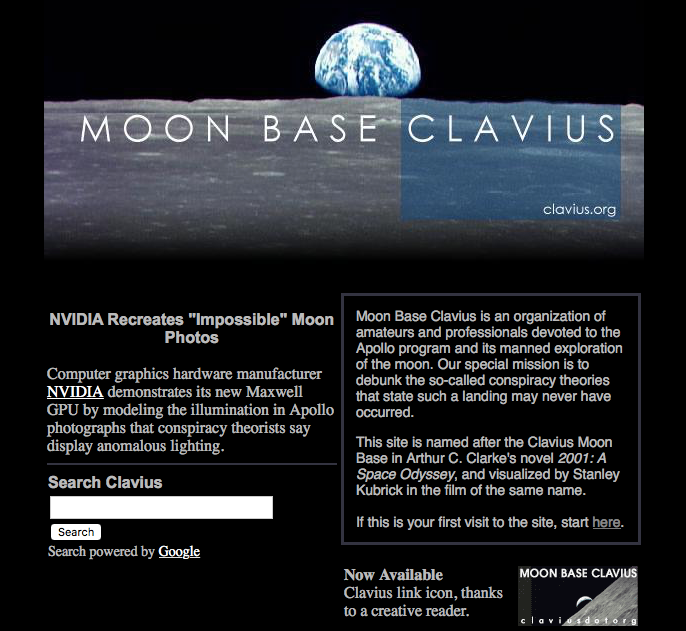
Home page on Clavius.org

Clavis, known as Moon Base Clavius  from the moon base on them movie 2001, is a debunking web site for the critics and theorists of the Apollo moon landings. As it states on the home page, “Moon Base Clavius is an organization of amateurs and professionals devoted to the Apollo program and its manned exploration of the moon. Our special mission is to debunk the so-called conspiracy theories that state such a landing may never have occurred.”

While it is loaded with useful information regarding the landings, technologies used and so forth, I felt something was slightly off with Clavious when I first starting checking it out.  Digging deeper I found this web site to be a total mystery as who created it and maintains it. The site does list a webmaster, Jay Windley, who claims to have training in engineering but never worked for NASA.  His bio does not state he authored any of the articles on Clavious nor is he listed as the owner of the web site.  The articles, while well written, do not feature any author names or copyrights.  There are no external links to sources used. There is no advertising, so no visible means of financial support.  Also, a Whois search has the ULR ownership unlisted.  Very odd, particularly if you want interested readers to take your seriously.

These are all the hallmarks of a intelligence agency operation. There are no authors, no sources, no copyrights and no monetization.  Why all the mystery?  Why no transparency as to who they are?  

Clavius reminds me of Snopes.  Snopes, supposedly a site for debunking urban myths, gives enough data to prove their point and ignores the difficult details that do not.  For example on Clavius, the Radiation Primer page has very useful information regarding radiation energies and effects.  It lists materials that are radiation blocking and some that are not.  However, it ignores the fact that those shielding materials are not present in the construction of the Apollo Command Module and the Lunar Landing Module.  Both are largely constructed of aluminum, a very poor radiation blocker.  But the reader is never informed of this.

Another radiation issue, the Van Allen radiation belts, the dangers are dealt with in typical fashion.  As stated, “And the Apollo navigators plotted a course through the thinnest parts of the belts and arranged for the spacecraft to pass through them quickly, limiting the exposure.”  

Apparently the anonymous author didn’t read Apollo 8 commander Frank Borman’s book, “Countdown” where on pages 203-204, he states they went through the thickest parts of the belts and only got the equivalent exposure of a chest x-ray.  No fancy flying here!  They just went head-on through the belts with little trouble.  Borman goes on to add, “So much for the dire predictions some scientists had made about harmful, perhaps fatal, exposure to the belt.”  Borman is dismissing the radiation hazard as being an over rated threat.

So who is lying here, Frank Borman or the anonymous writers at Clavius?

Likewise, there is no mention of plotting trajectories to avoid the harmful parts of the Van Allen belts in any NASA tech docs that I have read, nor is it ever mentioned in the transcripts of astronaut conversations.  They did a 5 minute burn for a “free return trajectory” to escape earth’s gravitational field and other than some minor course corrections, they sped on to enter the moon’s gravitational field.  No warping thru radiation densities as Frank Borman states in his book or in his follow-up book Apollo 8, co-written with 

The treatment of critics of the Apollo moon program are abysmal.  They are always referred to as “conspiracy theorists,” a term invented as a talking point by the CIA to discredit the critics of the Kennedy assassination investigation in press reports. Now it is used to attack critics of official Government accounts of everything from JFK to the 911 attacks. The anonymous writers at Clavius use this term repeatedly, implying there are no anomalies in the Apollo program, just a bunch of know-nothing conspiracy kooks.  That of course is not true.  Aulis.com has articles written by scientists and engineers who question effectively, many elements of the Apollo moon program.

So reader beware.  


Monday, December 24, 2018

The Backup Crew


NASA transcript lists a backup crew for Apollo 12.

I first heard of the Apollo backup crew on the Clyde Lewis radio show, Ground Zero in 2016.  Clyde’s guest was noted UFO researcher Richard Dolan.  During the interview, he played an audio clip (linked below) he had gotten from contacts in the aerospace industrial community regarding a conversation from Pete Conrad on Apollo 12 to mission control inquiring about a sighting of objects following them on the way to the moon.  Incredibly, besides the reason of spent boosters and ejected panels, at the end of the exchange, it was suggested that maybe they were being followed by a “backup crew.”

After some banter back and forth, here is the explanation given to them from the Mission Control in the transcript:

036:12:07 Carr: Roger, Pete. That thing you saw off the hatch, at a roll of 35 degrees, we figured there's probably three possible answers. Number 1: it could be the S-IVB, or possibly a SLA panel, or it could be the backup crew flying trail on you
036:12:24 Conrad: Roger. Actually we have two objects out there. One's not anywhere near as bright as the other, so I think the real bright one's the S-IVB and the other one's probably a SLA panel. They're about 20 degrees apart. And as far as the backup crew goes, tell them we'll meet them on the back side of the moon. 
One odd thing about this exchange, besides being an amazing admission of a hereto unknown event of the Apollo moon missions, is that this conversation was not on the Apollo Flight Journal website several years ago.  When it was reorganized with a new layout a while back, it was added.  My initial searches could not find it originally, but it has been returned to the official transcript.  I assumed at the time it was too hot to released to the public and was edited out.

Was this an inside joke or was it inside baseball?  Having a backup crew in space with the main crew on the flight to the moon adds a whole new dimension to the Apollo moon missions.  Where was this other crew launched from?  What type of crafts were they flying?  Ships from a secret space program?  

But it does not end with the backup crew acknowledgment.  In the final exchange about this issue, the following was said:

36:26:51 Conrad: That could be true but, gee whiz, when we turned around, I saw one of those SLA panels leaving the area at a high rate of speed; it looked to me like it was leaving us pretty - pretty rapid clip, like it got a lot more than a foot per second or so. 
036:27:21 Carr: Well, since we don't really have any idea how they left or what their trajectory could be, it's kind of tough really to say just what the heck that could be. 
036:27:33 Gordon: Okay. We'll assume it's friendly anyway, okay?
036:27:37 Carr: Roger. If it makes any noises, it's probably just wind in the rigging. 
036:27:41 Conrad: Okay. Understand. 
Most likely inside baseball on this one. Noises?  In the vacuum of space where no sound is transmitted?  Wind in the rigging?   Mission controller, Jerry Carr (who would command Skylab 4) seems to be talking in code.  And Conrad states that he understands what noises and “wind in the rigging” means.  Glad he does because I have no idea what he is talking about.  If not code, then what are they trying to say?  Too cryptic to be a joke.  

(The “friendly” comment was made by astronaut Dick Gordon, on board Apollo 12.)


Now, compare the transcript above to the Ground Zero broadcast and you will see how heavily edited the transcript is by NASA.  Link HERE.  There is actually more detail in Clyde Lewis’s audio clip.

Interjected into all of this are comments made by the NASA Public Affairs Office attempting to expand on what is going on here and making a poor attempt of it.   No statements explaining the meaning of the backup crew reference, only that Dave Scott (Apollo 15) working nearby, smiled at the comment. Were they using this to imply it was a big inside joke?  If so, they failed.  And Conrad mentions the backups in a matter of fact style with no inflection of voice implying a joke.  Likewise, the “wind in the rigging” remark is not addressed at all.

So we are left with another mystery from NASA.  It is interesting that they would release the transcript of NASA personnel discussing extra astronauts in space and then the notion of meeting up with them at the moon.  NASA did of course have backup crews for each flight, but the public was left with the impression they were available in case something happened to a scheduled crew member such as illness or death.  The logistical issues of a separate launch from a location other than the Kennedy Space Center and keep it under wraps would be an enormous undertaking.  It seems implausible but here they are talking about it.  Did it really happen and will we ever know?


Apollo Flight Journal Link with audio clips:


Tuesday, December 11, 2018

Of Spacesuits and Helmets

Neil Armstrongs's alleged spacesuit. Note the blue overboots.  They are gray in the moon images.

NASA documentation shows that Apollo spacesuits offered little to no radiation protection.


Studying the Apollo moon landings is about like studying the JFK assassination.  Down one rabbit trail after the other.  A very contradicting trail.  Some of the official statements and published documents that describe how the feat of building complicated space craft to land men on the moon in just 8 years, comes off as a poorly written science fiction drama where the author cannot keep his plot threads from conflicting.  In other instances, no explanation is available at all.  This not only includes NASA at the time of the Apollo program, but years later when the goal shifts back to returning to the moon with the Orion program.  

Spacesuits And Radiation
Radiation is probably one of the most hazardous conditions affecting manned space flight.  The fist hurdle is the Van Allen Radiation belts, the earth’s donut shaped force field.  It traps numerous particles and blocks the solar wind.  It is widely known that the belts are a great hazard and hence, impediment to manned space flight.  Dr. Van Allen stressed this fact in science articles in the late 1950’s.  Ironically, none of the astronauts in their books have an issue with these radiation belts, passing thru them, to and fro, with no harm.  Frank Borman commander of Apollo 8 stated in his book Countdown, that they traveled thru the thickest part of the Van Allen belts and the radiation exposure was the equivalent of a chest x-ray.  Even before Apollo, in 1966 Gemini flight 11 reached a record altitude of 875 miles above earth which would place them in the first of the two belts.  Once again, no harm was reported.

Once past that, the moon presents a toxic hazmat zone filled with an unrelenting flow of radiative particles such cosmic radiation, gamma rays, microwaves, x-rays and on on.  Even the ground soil is radiated.  A study of the Apollo spacesuit and its development and use, not much is said regarding the radiation shielding in the suit.  In NASA’s spacesuit manual, they list numerous layers of aluminized mylar film used in the suit interior to protect the astronaut.  The manual specifically makes note that multiple layers of aluminized mylar were used for the protection of thermal radiation.  Thermal is heat.  You can experience that on a sunny day at the beach.  But that is not nuclear radiation.  In this case, NASA is defining the suit as protecting the astronaut from environmental conditions which is needed with the moon surface temperature in direct sunlight ranging form 260 to 280 degrees Fahrenheit (123-137 C). 

The only other radiation listed in the manual is ultraviolet radiation which can damage the astronaut’s eyes, solved by the use of the gold visor.  

Nuclear radiation hazards are never mentioned or addressed for the safety of the astronaut wearing the suit.

Even TV documentaries are silent about this issue, such as the episode of Moon Machines on the SCI Channel discussing the development of the Apollo spacesuit.  It never mentioned radiation shielding in the resulting design.  One would think this would be an important feature to develop for the safety of the astronauts.  But once again, it is never mentioned. 

Researcher Marcus Allen, a believer in the moon hoax theory, said he contacted a contractor building spacesuits and inquired about the radiation shielding used in the suit.  They told him to contact NASA as they didn’t build shielding in the suits they constructed for use by the astronauts. 

The moon itself is radioactive.  NASA’s science site (see link below) states that gamma rays cause nuclear reactions in the soil making it radioactive.  Astronauts said the moon dirt got all over their suits and gear, with one astronaut stating that some got in his mouth.  Yet, none of them ever got radiation sickness or resulting health issues from exposure to moon dirt. 

How do the “experts” deal with these conflicting issues?  They simply state that the astronauts were not in the intense radiation zones (Van Allen belts, cislunar space, the moon) long enough to experience any serious effects from life threatening radiation.  Which is nonsense.  Russian scientists about in the 1960’s concluded that the radiation was severe enough to require 4 feet of lead shielding which is utterly impractical.  It is hard to understand how the astronauts could have survived in such a toxic environment regardless of how long they were there in EVA on the moon and not suffer serious consequences.  The proper shielding is not there as stated in NASA documents.  None of the Apollo astronauts who were alleged to have flown to, or landed on the moon, were ever effected by radiation sickness during, or after, the missions.  And all of this with spacesuits, as stated above in multiple NASA technical reports, that did not have proper radiation shielding!  These suits could not be used for Hazmat work on earth during a nuclear power plant emergency, so why would they be any good for use in the most dangerous radiation zone of them all—the surface of the moon?

Apollo 8 astronaut Bill Anders.  Note the lack of shielding or insulation in his plastic helmet.

The Helmet
Besides the lack of radiation shielding from the suit, it should be noted that the spacesuit helmet, crafted from Lexan polycarbonate (i.e., plastic), has no shielding from either thermal or nuclear based radiation, nor insulated from conditions of extreme heat or cold.  The only safeguard is the gold visor for the afore mentioned ultraviolet radiation, which is the only type of radiation protection, besides thermal, which is heat, listed in NASA’s documentation.  The polycarbonate material is rated to handle temperatures up to 297 degrees Fahrenheit, safe enough for surface temperatures on the moon, although it will deform at above 240 degrees Fahrenheit (something never seen or documented by NASA).  There is no data on this form of plastic in conjunction with below freezing temperatures.

Underneath the suit the astronauts wear a liquid cooling garment (LCG) featuring water filled tubes for keeping the astronaut cool. (It is unknown how this cooling system turned warm for the severely cold shadow areas on the moon.) It fully covers the body and is used in spacesuits to this day.  However, while the tubing extends to the feet, it does not cover the head or the hands. As already stated, there is no thermal insulation in the helmet but the outside is covered in beta cloth which is flame resistant, but it is not explained how this protects the person inside from the severe extremes of temperature and radiation on the moon’s surface.  It seems unlikely that the astronaut’s hands would be safe in the temperature extremes with the type of insolation protection the suit’s gloves provided.  

The end result is a helmet that offers little way of protect from the moon’s extreme environmental conditions.  Even NASA’s gamma ray experiments on the helmet showed no protection at all, with the gamma rays easily passing through the thin polycarbonate structure.  

In Summary
There is a disturbing lack of concern for the hazards astronauts encounter in space and on the moon. Astronauts in their interviews and written accounts say precious little regarding this mortal danger. And no proper explanation is coming forth form NASA as their documentation is sorely lacking in solving this issue.  Basically, the spacesuit’s purpose is to offer protection from extremes of heat and cold, micrometers, vacuum of space, low gravity and visual protection.  One will never read about protection from x-rays, gamma rays, ionized protons or any other types of radiation that will be present on the moon’s surface.  It is as if radiation hazards do not exist at all!

If NASA put men on the moon they were using classified technology to accomplish the mission.  There is apparently no radiation protection in their suits.  Or else, they didn’t go at all and the moon landings were one big charade on the American tax payers and the world.  Or, the true nature of space and it’s properties and hazards has not been explained to us at all.

If people don’t believe that man landed on the moon it is NASA’s fault.  Go to their web site and do some research and you will see why.


Sources

Spacesuit manual

Space Helmet

Lexan Polycarbonate

Moon Soil Radioactive

NASA Technical Docs Site

Aluminum Shielding

Aluminum not a good block for Gama rays